

 Released:2025-12-19 11:17:02
 Views 1402 次
 随着精准医疗、可穿戴健康监测技术的快速发展,生物电势(如脑电 EEG、心电 ECG)采集对模数转换(ADC)芯片的性能提出严苛要求。生物医疗信号普遍具有微弱幅度、低频特性及易受工频干扰等特点,同时设备面临小型化、低功耗、多通道适配等开发挑战。芯佰微CBM24AD99Q 作为专为脑电图和生物电势测量设计的低噪声 24 位 ADC 芯片,以“精准采集 + 高度集成 + 灵活适配”为核心,对抗传统通用ADC芯片难以兼顾精度、集成度与场景适配性,成为解决医疗设备信号采集痛点的优选方案。

With the rapid development of precision medicine and wearable health monitoring technologies, the acquisition of bioelectrical potentials (such as electroencephalogram [EEG] and electrocardiogram [ECG]) imposes stringent requirements on the performance of analog-to-digital converter (ADC) chips. Biomedical signals are generally characterized by weak amplitude, low-frequency properties, and susceptibility to power line interference, while devices face development challenges such as miniaturization, low power consumption, and multi-channel compatibility. The Corebai Micro CBM24AD99Q, a low-noise 24-bit ADC chip specifically designed for EEG and bioelectrical potential measurements, adopts a core approach of "precise acquisition + high integration + flexible adaptation." This addresses the limitations of traditional general-purpose ADC chips in balancing precision, integration, and scenario adaptability, making it the preferred solution for overcoming the pain points in medical signal acquisition.
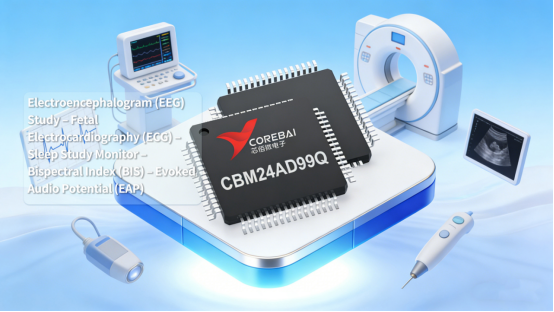
The chip adopts a 24-bit Δ-Σ architecture, with input reference noise as low as 1μVPP (70Hz bandwidth) and input bias current as low as 300pA. Coupled with a 121dB signal-to-noise ratio (SNR) and 8ppm integration nonlinearity (INL), it accurately reconstructs weak signal details such as μV-level EEG and fetal ECG. It also offers 4/6/8 channel version options, with each channel equipped with an independent low-noise programmable gain amplifier (PGA), supporting 1, 2, 4, 6, 8, 12, and 24 times programmable gain. The data rate ranges from 250SPS to 16kSPS.
The CBM24AD99Q chip features a medical-grade anti-interference design with a Common Mode Rejection Ratio (CMRR) of-110dB, effectively suppressing 50/60Hz power line interference. It incorporates a built-in BIAS bias driver circuit and SRB1/2 reference electrode pins to further mitigate common-mode interference.
The product integrates a programmable gain amplifier, internal voltage reference, oscillator, lead drop detection module, and temperature sensor, eliminating the need for additional external core components. It adopts a compact TQFP-64 (10mm×10mm) package. The device is compatible with ADS1299 pins and programming, supports SPI serial interface, and enables high-channel system expansion through daisy-chain cascading. It offers both continuous and single-shot conversion modes, suitable for real-time monitoring and scheduled sampling scenarios. In terms of operating temperature range, the CBM24AD99Q covers-40°C to +85°C, with an ESD rating of ±1000V and a junction-to-environment thermal resistance of 46.2°C/W, meeting the reliability requirements of medical devices in various scenarios such as operating rooms and outdoor emergency situations.
Typical application scenarios
Electroencephalogram (EEG) research: Low-noise characteristics are optimized for μV-level EEG signal acquisition, with multi-channel configuration supporting multi-lead brain function monitoring, facilitating epilepsy diagnosis and brain science research.
Fetal electrocardiogram (ECG): Featuring high CMRR and low-noise design, it effectively filters maternal signal interference to accurately capture the weak fetal ECG signals, ensuring the accuracy of prenatal monitoring.
Bispectral Index (BIS) monitoring: The 16kSPS high sampling rate meets the real-time monitoring requirements for anesthesia depth, rapidly responds to signal changes, and provides precise data support for surgical anesthesia.
010-62106066
( Monday to Friday 9:00 - 18:00 )
 704-705, Block D, Building 2, No. 9 Fenghao East Road, Haidian District, Beijing

Wechat Public Account





This app respects and protects the privacy of all users who use the service. In order to provide you with more accurate and personalized services, this app will use and disclose your personal information in accordance with this Privacy Policy. However, this application will treat this information with a high degree of diligence and prudence. Except as otherwise provided in this Privacy Policy, this application will not disclose or provide this information to third parties without your prior permission. This app will update this privacy policy from time to time. By agreeing to this Application Services Use Agreement, you are deemed to have agreed to the entire content of this Privacy Policy. This Privacy Policy is an integral part of this Application Service Agreement.


 Online Store
 A/D Converters (ADC)
 RF Transceiver
 Controller
 Power Management
 Logic gates
 Real-time clocks
 Digital Isolator
 Darlington Transistor
 D/A Converters (DAC)
 Sensors
 Analog Switches Multiplexers
 Interface
 Monitoring Circuit
 Amplifier

 在线商城
在线商城