

 Released:2026-01-23 13:32:09
 Views 939 次
 一、行业技术综述与痛点解析 激光测距(Laser Rangefinding)作为工业自动化、精密建筑测量及无人机避障的核心传感技术,其性能边界由模拟信号链的底层质量决定。在基于脉冲飞行时间(ToF)或相位差检测的逻辑中,系统面临着三大严峻挑战:一是如何在高本底噪声中完整捕获纳秒级(ns)的微弱脉冲回波;二是如何在毫微秒量级实现精准的阈值判决以降低系统误差;三是如何在剧烈的驱动电流波动下维持基准轨的纯净度。

1、Industry Technology Review and Pain Point Analysis
Laser ranging, a core sensing technology for industrial automation, precision construction surveying, and UAV obstacle avoidance, has its performance limits determined by the quality of the analog signal chain's foundational layer. In systems utilizing pulse time-of-flight (ToF) or phase-detection logic, three critical challenges emerge: (1) capturing nanosecond-level (ns) weak pulse echoes amidst high background noise; (2) achieving millisecond-level precision in threshold decisions to minimize system errors; and (3) maintaining the purity of reference tracks during intense drive current fluctuations.
Corebai, with years of expertise in high-performance analog integrated circuits, delivers comprehensive device solutions covering analog front-end, power management, voltage detection, and interface communication. Its portfolio includes operational amplifiers, comparators, linear regulators, RS-232 interface chips, and USB microcontrollers, forming a complete, mass-production-ready application-grade solution.
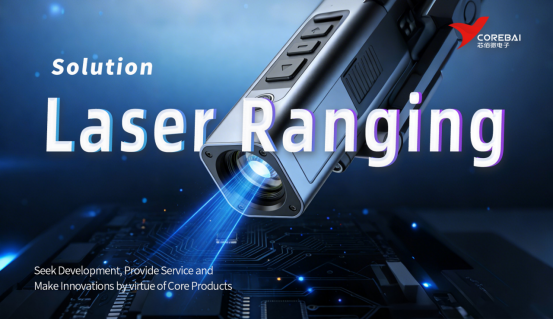
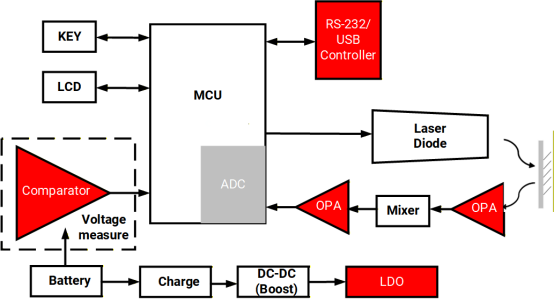
In this architecture, the functional allocation of Corebai Micro Devices is as follows:
The echo signal amplification is implemented by using the operational amplifiers CBM8051, CBMV358 and CBMV722.
The battery threshold detection is implemented by using CBM2903 comparator.
The voltage regulation module utilizes the CBM1117 linear regulator.
The external serial communication is CBM3232.
The system uses CBM9002 as the main controller and USB interface.
The echo signal output from photoelectric receiver usually has a very small amplitude and a steep edge, which needs a high-speed and low-noise amplifier for pre-processing.
The CBM8051 supports single-supply operation (2.5V-5.5V) with a rail-to-rail output architecture. It delivers a typical small-signal bandwidth of 150MHz-250MHz, featuring an input bias current of 1pA and a static current of approximately 2.8mA per channel.
In the system, CBM8051 is used as the preamplifier of the receiver, which amplifies the weak signal of the photoelectric receiver at high speed, and maintains low distortion and high bandwidth, providing a high quality analog signal for the subsequent mixing, filtering and sampling.
After demodulation or frequency mixing, the echo signal still requires amplitude adjustment, filtering and shaping, and then is driven to the ADC.
The CBMV358 features a gain bandwidth of approximately 1.1MHz and a static current of 60-80µA. It supports rail-to-rail input/output, millivolt-level input offset voltage, and picoampere-level input bias current, making it ideal for low-power filtering and buffering applications.
The CBMV722 features a 10MHz gain bandwidth and a slew rate of approximately 7V/µs, while also supporting rail-to-rail input/output, achieving an optimal balance between speed and power consumption.
In the system, these two types of operational amplifiers are mainly used to perform the secondary amplification of the signal after the mixer, active filtering, and ADC input buffering, ensuring that the signal amplitude, bandwidth, and stability meet the precision requirements of analog-to-digital conversion.
Laser rangefinder is usually powered by battery, so the battery status must be monitored in real time.
The CBM2903 is a dual-channel comparator with a supply range of 2V to 30V. It features a typical input offset voltage of ±1mV, microampere-level static current per channel, and an open-drain output structure with a response time of approximately 1.3µs.
In the system, the CBM2903 connects to the battery voltage divider network, compares the actual battery voltage with the preset reference threshold, and outputs the result to the MCU. This enables low-power alarm, full-charge detection, and system power-off protection logic. Its wide voltage range and low power consumption make it ideal for portable, long-endurance ranging devices.
The system's power supply architecture follows the sequence: battery → charge management → DC-DC boost → LDO voltage regulator, with the LDO utilizing the CBM1117 component.
The CBM1117 features a maximum input voltage of 15V, supporting fixed or adjustable outputs including 1.5V,1.8V,2.5V,3.3V, and 5V. It delivers a maximum output current of 0.8A with a typical voltage drop of 1.39V and a load regulation rate of 0.2% to 0.4%. The device also includes overcurrent and overheat protection.
In the laser rangefinder, the CBM1117 supplies low-noise, stable power to sensitive modules including MCU, operational amplifier, and ADC, effectively mitigating DC-DC boost ripple effects on analog front-end and measurement accuracy. This component is pivotal to system stability.
In industrial or debugging applications, the rangefinder often communicates with the host computer or control system via RS-232.
The CBM3232 supports EIA/TIA-232 standards, operates at 3.3V or 5V, and delivers a maximum communication rate of 120kbps. Featuring an integrated charge pump, it requires no external negative power supply and offers enhanced ESD protection.
In the system, the CBM3232 module converts between MCU TTL signals and RS-232 standard signals, enabling parameter configuration, data export, and field maintenance to meet industrial-grade communication interface requirements.
The system's main controller utilizes the CBM9002 USB microcontroller, which is based on an enhanced 8051 core. It supports operating frequencies of 12MHz, 24MHz, and 48MHz, with 16KB SRAM integrated on the chip. The device operates at 3.3V with a 5V input voltage tolerance, features a built-in USB2.0 transceiver for full-speed and high-speed modes, and provides UART, I2C, and multi-channel GPIO interfaces.
The CBM9002 laser rangefinder features an integrated USB interface, enabling direct PC connection for data transfer, system upgrades, and debugging.
The solution achieves a balance between performance, power consumption, and system integrity, providing a mature, mass-production-ready, and domestically replaceable integrated solution for laser ranging equipment in engineering surveying, industrial inspection, and portable applications.
Technical Statement: All product specifications herein shall be subject to the latest version published by CoreBai Microelectronics.
010-62106066
( Monday to Friday 9:00 - 18:00 )
 704-705, Block D, Building 2, No. 9 Fenghao East Road, Haidian District, Beijing

Wechat Public Account





This app respects and protects the privacy of all users who use the service. In order to provide you with more accurate and personalized services, this app will use and disclose your personal information in accordance with this Privacy Policy. However, this application will treat this information with a high degree of diligence and prudence. Except as otherwise provided in this Privacy Policy, this application will not disclose or provide this information to third parties without your prior permission. This app will update this privacy policy from time to time. By agreeing to this Application Services Use Agreement, you are deemed to have agreed to the entire content of this Privacy Policy. This Privacy Policy is an integral part of this Application Service Agreement.


 Online Store
 A/D Converters (ADC)
 RF Transceiver
 Controller
 Power Management
 Logic gates
 Real-time clocks
 Digital Isolator
 Darlington Transistor
 D/A Converters (DAC)
 Sensors
 Analog Switches Multiplexers
 Interface
 Monitoring Circuit
 Amplifier

 在线商城
在线商城