

 Released:2026-10-21 14:01:47
 Views 8 次
 将24V、12V等输入电压稳定转换为3.3V、5V、12V等工作电压,工程师往往需要在效率、开发难度和系统成本之间寻找平衡。 传统三端线性稳压器虽然外围简单、设计成熟,但输入输出压差几乎全部转化为热量,输出电流稍大便需要额外散热;而传统开关电源方案虽然效率更高,却通常需要工程师完成控制器选型、功率器件配置、补偿网络设计以及磁性器件匹配,开发周期和调试难度明显增加。对于中等功率(安培级)供电应用而言,如何在保持较高转换效率的同时,尽可能降低设计复杂度,一直是电源设计中的核心需求。 芯佰微的 CB

When stabilizing input voltages such as 24V and 12V into operating voltages like 3.3V,5V, and 12V, engineers often need to strike a balance between efficiency, development complexity, and system cost.
Traditional three-terminal linear regulators, despite their simple external circuitry and well-established design processes, convert nearly the entire input-output voltage difference into heat; furthermore, even a modest increase in output current necessitates additional heat dissipation. In contrast, conventional switching power supply solutions, while offering higher efficiency, typically require engineers to perform tasks such as selecting appropriate controllers, configuring power devices, designing compensation networks, and matching magnetic components—thereby significantly extending the development cycle and complicating the debugging process. For medium-power (ampere-level) power supply applications, the core challenge in power supply design has been how to achieve high conversion efficiency while minimizing design complexity as much as possible.
Corebai Micro's CBM2576 series 3A buck switching regulator provides a solution by integrating a high-voltage-side power switch, a fixed-frequency oscillator, and comprehensive protection features. For fixed-output applications, this device enables engineers to complete a Buck regulator design using only a few peripheral components, facilitating the rapid development of stable and reliable DC-DC power solutions.
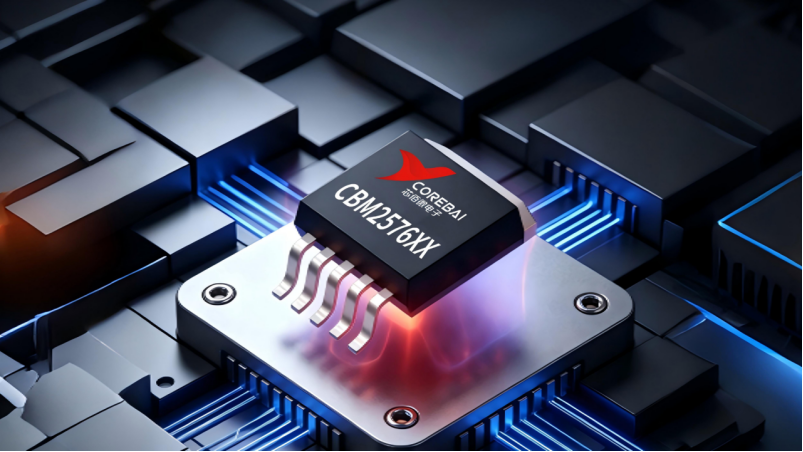
A single chip completes the design of a 3A buck power supply.
For many engineering projects, the primary focus of power supply design is not to pursue peak performance, but rather to expedite development and smoothly transition to mass production.
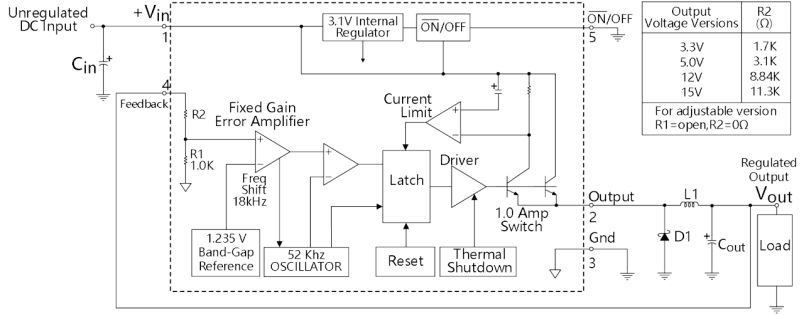
The CBM2576 features an integrated high-voltage-side power switch, a 52 kHz fixed-frequency oscillator, per-cycle current limiting, and thermal shutdown protection. It delivers a maximum continuous output current of 3 A, supports fixed-output versions at 3.3 V, 5 V, 12 V, and 15 V, and also offers adjustable-output models ranging from 1.23 V to 37 V, enabling it to meet the power supply requirements of diverse systems.
For fixed-output versions, a typical Buck converter design requires only a few peripheral components—such as an input capacitor, an output capacitor, an inductor, and a freewheeling diode—to complete the design; for adjustable versions, merely adding a feedback resistor suffices to set the output voltage. This highly integrated design reduces the number of peripheral components, minimizes power supply debugging efforts, and enables engineers to devote more resources to the development of the overall system functionality.
|
product model |
temperature range |
package |
|
CBM2576DS ADJ |
-40℃~125℃ |
TO 220 5 |
|
CBM2576DT ADJ |
-40℃~125℃ |
TO 263 5 |
|
CBM2576DS 3.3 / 5.0 /12 /15 |
-40℃~125℃ |
TO 220 5 |
|
CBM2576DT 3.3 /5.0 /12 /15 |
-40℃~125℃ |
TO 263 5 |
A mature architecture that reduces uncertainty in engineering design
In recent years, high-frequency synchronous Buck converters have continued to evolve, with devices becoming increasingly smaller and their efficiency progressively higher. However, for applications such as industrial control systems, instrumentation devices, and power modules, stability, maturity, and long-term reliability often take precedence over peak performance.
The CBM2576 employs a fixed switching frequency of 52 kHz, with its oscillation frequency remaining within the specified range across the full operating temperature range of 40 °C to 125 °C. Compared to high-frequency solutions, this design features relatively larger peripheral magnetic components; however, it benefits from well-established design experience, a wide availability of component sources, and greater ease for engineers in PCB layout and EMC optimization. For industrial equipment requiring long-term stable operation, a thoroughly validated power supply solution itself constitutes an integral part of product reliability.
The focus is not only on efficiency, but also on system reliability.
Unlike three-terminal linear regulators, which convert the entire voltage drop into heat, the CBM2576 employs a switching buck architecture, enabling it to effectively reduce system heat generation and improve power conversion efficiency under typical operating conditions. Lower temperature rise translates to:
· Reduce the size of the heat sink, thereby simplifying the structural design process;
· Enhance the overall system reliability and mitigate device aging caused by temperature rise;
· Improve power utilization efficiency and reduce system power consumption;
· Provide a more stable power supply environment for the continuous operation of industrial equipment.
What engineers truly care about is "ease of design."
The built-in protection mechanisms provide reliable safeguards. The device features per-cycle peak current limiting and thermal shutdown; more practically, in the event of an output short circuit or overload, the output voltage drops to approximately 40% of its nominal value, the oscillation frequency synchronously decreases to around 18 kHz, and the minimum duty cycle decreases from 5% to approximately 2%. This self-protection logic reduces the chip's average power consumption, thereby preventing burnout under fault conditions. In terms of board-level design, this ensures that a short circuit in the downstream stage will not immediately cause the upstream stage to fail.
The enable pin is controllable, and standby power consumption is extremely low. The ON/OFF pin accepts TTL levels: pulling it low enables the device, while pulling it high disables it. The typical standby current is only 80 µA (up to 200 µA in the off state). This pin is highly suitable for zoned power supply, power-on retention, or MCU-controlled power sequencing, and consumes virtually no power when disabled.
A wide range of applications to meet diverse power supply requirements
This product line covers a broad range of applications, primarily falling into the following categories:
· PLCs and automation control equipment for the electrical industry;
· Power supply modules and communication equipment;
· Instruments, meters, and testing equipment;
· LED driver and display control system;
· Embedded control boards and microcontroller systems;
· Battery-powered devices and related power supply systems.
Meanwhile, for specialized topologies such as Buck-Boost and inverting output configurations, engineers should conduct output capability assessments using reference circuits during the design phase, rather than directly applying the output capability specifications of standard Buck applications.
Reliability and proven performance remain key value propositions for industrial power supplies.
An excellent power management chip does not necessarily feature the highest switching frequency, nor does it necessarily have the smallest package size. What truly matters is whether it enables engineers to build a stable, reliable, and long-term operational power system with lower development costs and shorter debugging cycles.
The CBM2576 is designed for mature 3A buck regulator applications. With its highly integrated architecture, comprehensive protection mechanisms, and extensive application support, it achieves an optimal balance among development efficiency, system reliability, and engineering practicality. For industrial control systems, power modules, instrumentation devices, and conventional embedded products, this chip is not merely a DC-DC buck regulator; it represents a complete power solution, rigorously validated through real-world engineering applications.
010-62106066
( Monday to Friday 9:00 - 18:00 )
 704-705, Block D, Building 2, No. 9 Fenghao East Road, Haidian District, Beijing

Wechat Public Account


This app respects and protects the privacy of all users who use the service. In order to provide you with more accurate and personalized services, this app will use and disclose your personal information in accordance with this Privacy Policy. However, this application will treat this information with a high degree of diligence and prudence. Except as otherwise provided in this Privacy Policy, this application will not disclose or provide this information to third parties without your prior permission. This app will update this privacy policy from time to time. By agreeing to this Application Services Use Agreement, you are deemed to have agreed to the entire content of this Privacy Policy. This Privacy Policy is an integral part of this Application Service Agreement.


 Online Store
 A/D Converters (ADC)
 RF Transceiver
 Controller
 Power Management
 Logic gates
 Real-time clocks
 Digital Isolator
 Darlington Transistor
 D/A Converters (DAC)
 Sensors
 Analog Switches Multiplexers
 Interface
 Monitoring Circuit
 Amplifier


 在线商城
